Performance is relative. You might think your website is doing great because traffic is up 10% this year, but if your competitors are up 50%, you're actually losing market share. In the digital world, you can't measure success in a vacuum.
Benchmarking is the process of comparing your website's performance metrics against industry leaders and direct competitors. It allows you to identify exactly where you are falling behind and more importantly where the opportunities for growth are hidden. Let's look at how to use the SiteWorthIt Comparison Tool to master your market.
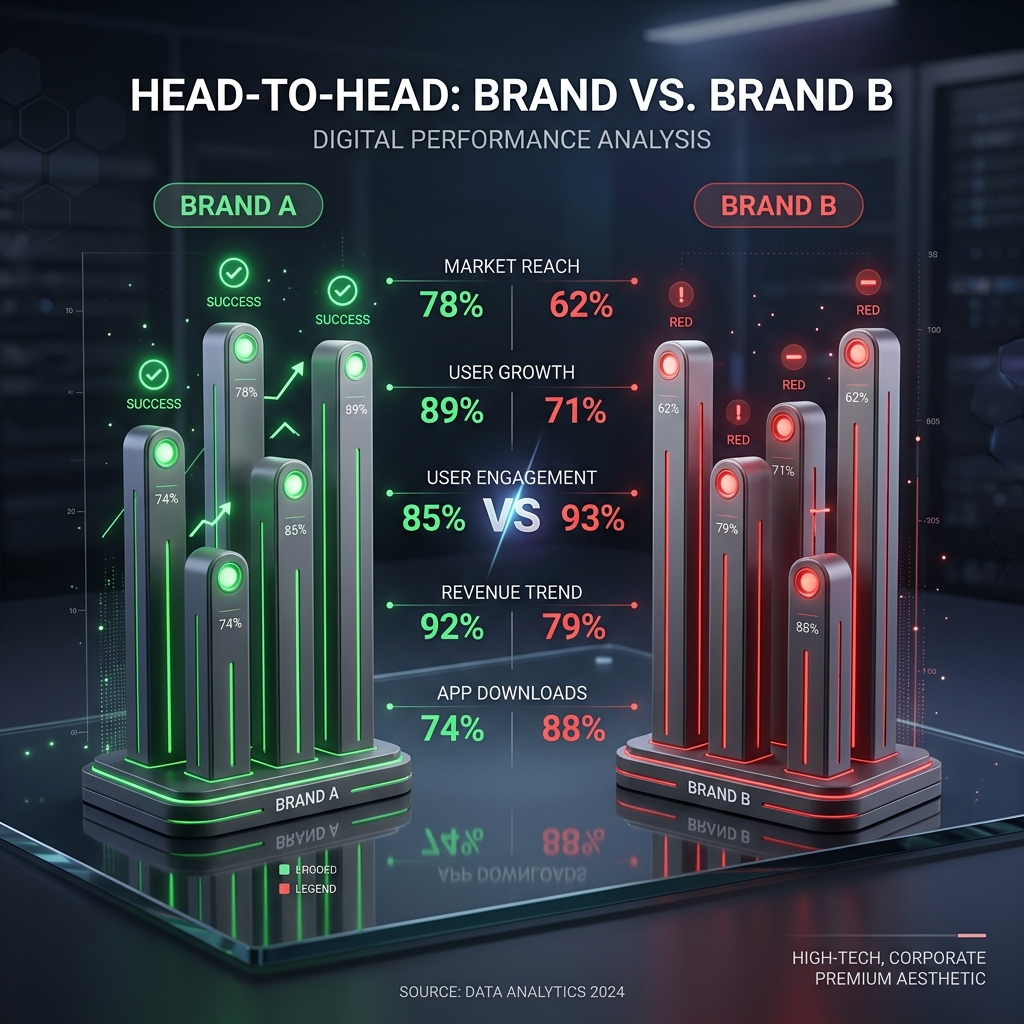
Precision Benchmarking: Identifying high-growth opportunities through side-by-side analysis.
1. The Four Horsemen of Benchmarking
When comparing two websites, there are four key metrics you must analyze to get a complete picture of the "authority gap":
- Traffic Multiplier: How many more visitors does the leader get? If they have 5x your traffic, it's time to audit their content frequency.
- Revenue Efficiency: Do they earn more per visitor? This highlights gaps in their monetization strategy vs. yours.
- Domain Authority (DA): This is the single biggest predictor of ranking potential. If their DA is 20 points higher, they can outrank you even with "worse" content.
- Backlink Velocity: Are they gaining links faster than you? This shows the health of their SEO and PR outreach.
2. Spotting the "Content Gaps"
Using the SiteWorthIt Compare Tool, you can quickly see the difference in "Indexed Pages." If your competitor has 5,000 indexed pages and you only have 500, the "secret" to their traffic isn't magic it's volume. Benchmarking gives you a concrete target for how much content you need to produce to be competitive.
1 Choose Your Benchmark
Identify the top site in your niche the one you want to eventually beat. Enter your URL and theirs into the Comparison Tool.
2 Look at the "Winners"
Our tool automatically highlights which site "wins" in each category (Traffic, Revenue, DA). Focus your efforts on the category where you are losing by the largest margin.
3 Set Your 90-Day Goals
Don't try to close a 5x traffic gap overnight. Use the data to set a realistic 90-day goal, like "Increase DA by 5 points" or "Double Backlink Count."
3. The Psychology of Winning
Benchmarking isn't just about technical SEO; it's about mindset. When you see that a "massive" competitor actually has achievable numbers, it makes the goal feel real. Data turns an intimidating giant into a set of targets that can be systematically overtaken.
Setting Realistic Benchmark Targets
One of the most common benchmarking mistakes is comparing a site that launched 6 months ago against a competitor that has been building content and backlinks for a decade. The authority gap isn't a measure of your content quality — it's a measure of compounding time. A site with 10 years of indexed content, 5,000 referring domains, and deep topical coverage cannot be replicated in a year regardless of budget or effort. If you treat that site as your benchmark, you will consistently feel like you're failing when you're actually ahead of pace for your site's age.
The right benchmark target is a site that is 1 to 2 years ahead of you, not 10. Find the competitor that was roughly where you are now two years ago and has grown steadily since — that trajectory is your realistic model. Use the SiteWorthIt comparison tool to pull domain registration dates and backlink histories alongside traffic data. Set 90-day targets based on the gap between your current metrics and where your reference site was at the same age, not where it is today. This framework turns an intimidating comparison into an achievable milestone sequence.
The Metrics That Actually Predict Growth
Traffic volume is a lagging indicator — it reflects what your SEO has already accomplished. The metrics that predict where your traffic will be in 6 months are behavioral engagement signals that sit one layer beneath the headline number. Time on site tells you whether visitors are finding what they came for; sites with average session durations above 2.5 minutes consistently outrank competitors with lower engagement over time, because dwell time feeds back into Google's ranking algorithm as a quality signal. Pages per session above 1.8 indicates that your internal linking and content structure are working — visitors are exploring rather than bouncing. Return visitor rate above 20% signals that you're building an audience, not just attracting one-time search traffic. Audiences return; search traffic doesn't, on its own, unless the content is good enough to bookmark or subscribe to.
These three metrics are available for free in Google Analytics 4. Review them monthly alongside your traffic numbers. A site with flat traffic but rising engagement metrics is on the verge of a ranking breakout — Google is collecting the user signals it needs to push the best pages up. A site with growing traffic but falling engagement is importing visitors who aren't satisfied, which can trigger ranking corrections in the next algorithm update.
Conclusion: Knowledge is Power
Stop working in the dark. Head over to our Website Comparison Tool today and see exactly how you stack up against the best in your industry. Once you have the data, you have the roadmap to the top.
Related Reading: Competitor Spying Guide | Top Website Lists