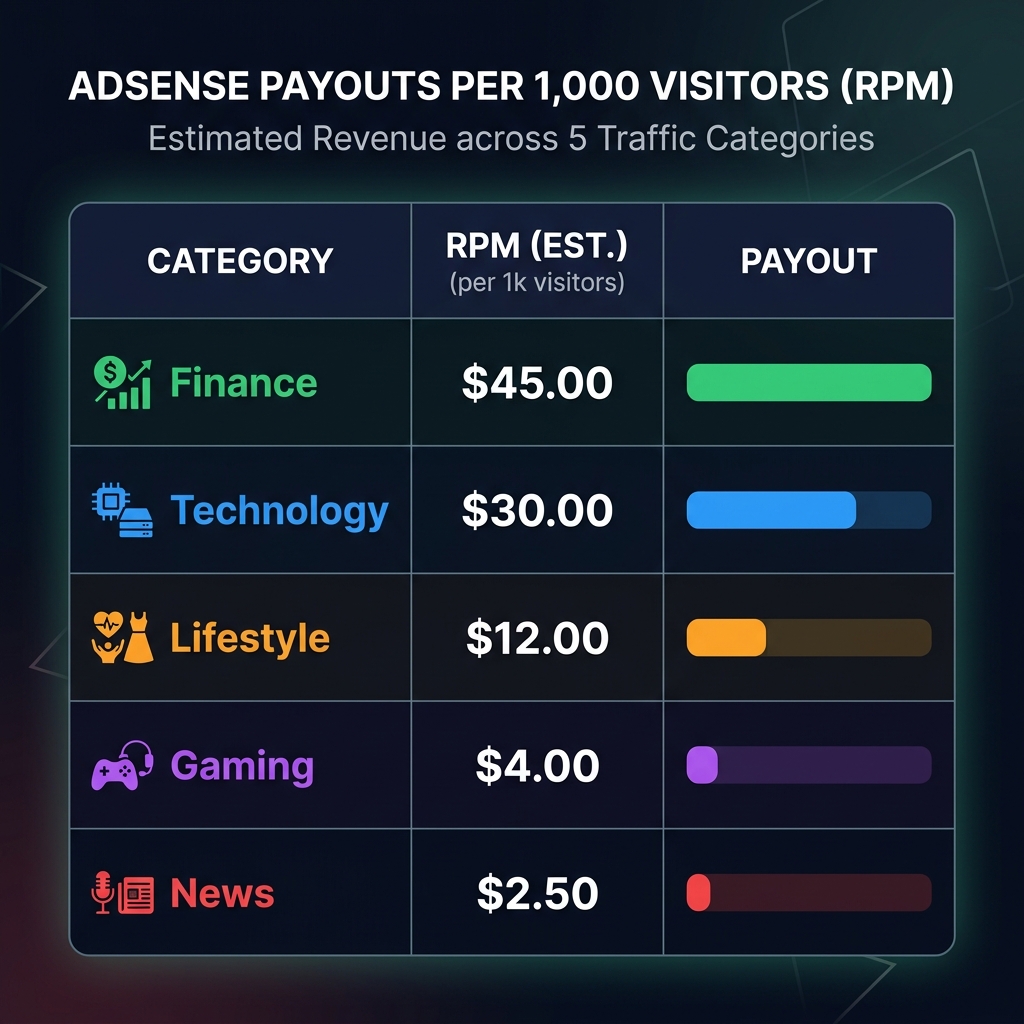
If you know a website's traffic, you can estimate its ad revenue within ±25% using a single formula and the right niche RPM. This guide gives you both plus a worked example and a free calculator that pulls real traffic data from DataForSEO.
The formula
RPM is the revenue a site earns per 1,000 pageviews. Note: pageviews ≠ visits. A typical blog has 1.5–2.5 pages per session, so 100k visits ≈ 150k–250k pageviews.
Step 1: Get real pageview numbers
For your own site, GA4 shows exact pageviews. For any other site, paste the domain into SiteWorthIt's free traffic checker and multiply the monthly visitors by your niche's pages-per-session average (see next section).
Pages-per-session by site type
| Site type | Pages / session | 100k visits → pageviews |
|---|---|---|
| SaaS blog | 1.6 | 160k |
| Personal blog | 1.8 | 180k |
| Recipe blog | 2.1 | 210k |
| News site | 2.8 | 280k |
| Forum / community | 6.5 | 650k |
| E-commerce | 5.0 | 500k |
Step 2: Pick the right RPM
| Niche | Low RPM | Avg RPM | High RPM |
|---|---|---|---|
| Finance / investing | $12 | $22 | $45 |
| Insurance / legal | $18 | $35 | $80 |
| SaaS / B2B | $10 | $18 | $30 |
| Health / wellness | $8 | $14 | $22 |
| Home / DIY | $10 | $20 | $35 |
| Food / recipes | $10 | $18 | $28 |
| Travel | $6 | $12 | $20 |
| Tech / gadgets | $5 | $10 | $18 |
| News / politics | $3 | $7 | $14 |
| Entertainment | $2 | $5 | $10 |
| Gaming | $2 | $4 | $8 |
Geography multiplier: US / UK / CA / AU traffic is worth 2–4× tier-3 traffic. If the site's top country isn't US/UK/CA/AU, shade toward the "low" column.
Step 3: Apply the formula (worked example)
264,000 × 22 ÷ 1,000 = $5,808 / month from display ads alone.
Finance-heavy sites typically 2–3× that with affiliate revenue on top, so blended gross = ~$15,000–$18,000/month. That matches what similar sites report on public Flippa listings.
What can throw off the estimate
- Ad density. 1 unit per page vs 6 units per page = 6× difference at the same RPM.
- Ad network. AdSense floor vs Mediavine/Raptive premium. Raptive is typically 2–3× AdSense for the same site.
- Traffic source. Organic search pays more than social (better engagement). Social-heavy sites come in below niche average.
- Seasonality. Q4 (Oct–Dec) is 1.5–2× Q1 for most niches.
- Page type. Commercial-intent pages ("best X for Y") monetize 3–5× better than pure informational.
Skip the math
Our free website checker calculates all of this automatically from DataForSEO data visits, niche, country-mix, estimated RPM → revenue range. Takes 3 seconds, no sign-up. For owned sites, use the Revenue Calculator to stress-test different RPM and ad-density scenarios.
When to demand real numbers
For acquisition due diligence, estimate-based revenue isn't enough. Demand:
- Google Analytics 4 read-only access
- Last 12 months of AdSense / Mediavine earnings screenshots
- Affiliate dashboard exports (Amazon, Impact, ShareASale)
- Stripe / PayPal statements for digital-product revenue
RPM Benchmarks by Niche (2026)
RPM — revenue per 1,000 pageviews — is the single most useful number for estimating what a website actually earns from display advertising, yet it varies by a factor of 10 or more across different content categories. The reason comes down to advertiser competition: a personal injury law firm is willing to pay dramatically more to reach someone reading about "car accident compensation" than a cereal brand is willing to pay to reach someone reading a recipe for banana bread. Understanding where your niche sits on the RPM spectrum is essential before you can make any meaningful revenue estimate.
The table below reflects 2026 benchmark data for sites with predominantly US, UK, Canadian, or Australian traffic. Sites with significant tier-2 or tier-3 geographic traffic should scale these figures down by 40–70%, as advertiser demand for non-English-speaking markets or lower-income geographies is meaningfully lower.
| Niche | Typical RPM | Why |
|---|---|---|
| Finance / Insurance | $15–40 | Highest-value advertisers, very competitive keywords |
| Legal | $12–35 | Personal injury, malpractice ads command huge CPCs |
| Healthcare | $8–20 | Pharma + health insurance + supplement advertisers |
| Technology / SaaS | $8–18 | B2B software has high lifetime value, advertisers pay well |
| Real Estate | $6–15 | High-ticket purchase, willing-to-pay advertisers |
| Education | $5–12 | EdTech companies compete aggressively for students |
| Travel | $4–10 | Seasonal, booking.com/Expedia dominate ad spend |
| Food / Recipe | $3–8 | Lots of traffic, lower advertiser competition |
| General Interest | $2–6 | Catch-all, low advertiser specificity |
| Entertainment | $1–4 | High traffic but advertisers see low conversion intent |
A few patterns worth understanding here. First, RPM and traffic volume tend to move in opposite directions: the highest-RPM niches (finance, legal) are also the most competitive and hardest to build organic traffic in. The highest-traffic niches (entertainment, news, food) command the lowest RPMs. This creates a fundamental tradeoff — you can optimize for traffic volume or for revenue-per-visitor, but the niches that offer both simultaneously are rare and extremely competitive. Second, RPM is not fixed — it is an output of your ad network, your ad density, your traffic source mix, and your content's commercial intent. A finance site getting 80% of its traffic from social media will earn substantially less than the same site getting 80% from Google organic, because the intent signals differ dramatically.
The AdSense Math: How to Actually Calculate Your Earnings
The core formula is simple: Monthly Revenue = (Monthly Pageviews / 1,000) × RPM. But the inputs to that formula require more care than they usually get, and the gap between a careful estimate and a careless one can easily be a factor of three or more.
Start with a concrete example. A health and wellness blog with 100,000 monthly visitors, 1.8 pages per session, generates approximately 180,000 pageviews. At a mid-range health niche RPM of $12, the estimate is: 180,000 / 1,000 × $12 = $2,160 per month. That is the baseline. Now let us work through the variables that change it.
The first thing to understand is the distinction between page RPM, session RPM, and impression RPM — three different metrics that AdSense reports, and three different numbers that mean different things. Page RPM is revenue per 1,000 pageviews — the most intuitive and the one most useful for site-level estimation. Session RPM divides total revenue by sessions rather than pageviews; for sites with high pages-per-session, session RPM will be higher than page RPM. Impression RPM divides revenue by ad impressions rather than pageviews; if you have five ad units per page, your impression RPM will be roughly one-fifth of your page RPM. When someone cites "RPM" without qualification, they almost always mean page RPM. That is the figure to use for revenue estimation.
Ad placement has an outsized effect on earnings. Ads displayed in the top half of the page — what the industry calls "above the fold" — are seen by virtually every visitor who loads the page. Ads below the fold are only seen by users who scroll far enough to encounter them. Studies consistently show that above-fold ad units earn 2–3× the CPM of below-fold units for the same traffic, because viewability scores directly affect how much advertisers bid. A site with one well-placed above-fold banner can outperform a site with six poorly-placed units scattered through the footer.
Ad density creates a diminishing returns curve that can turn into a negative returns situation. Google's Better Ads Standards define thresholds beyond which ad density begins to harm user experience. Sites that cross those thresholds can trigger a layout-based penalty that suppresses organic rankings — which reduces traffic, which reduces total revenue even if RPM holds steady. The practical ceiling for most content sites is three to four ad units per page for long-form content, fewer for shorter posts. Chasing a higher per-page impression count by stuffing ads rarely pays off and often backfires.
Finally, auto-ads versus manual placement is a genuine tradeoff. Auto-ads are easier to implement — AdSense places them algorithmically across your pages — and they can surface placements you would not have thought to test manually. But they also give you less control over where ads appear, which matters for brand aesthetics and for avoiding placements that break content flow. Manual placement requires more setup but gives you precise control, and for sites with a defined layout and a clear understanding of their high-viewability real estate, manual placement typically outperforms auto-ads by 15–30%.
Beyond AdSense: Diversifying Ad Revenue
AdSense is the easiest ad network to get started with, but it is rarely the best long-term option for sites that have grown to meaningful scale. Understanding what is available beyond AdSense — and when to make the switch — is one of the highest-leverage revenue decisions a publisher can make.
Mediavine is the most popular premium ad network for mid-sized content sites, with an entry requirement of 50,000 sessions per month. For sites that qualify, the RPM improvement is substantial: typical page RPM on Mediavine runs $15–25 for the same site that was earning $5–12 on AdSense. The improvement comes from Mediavine's direct advertiser relationships, header bidding infrastructure, and more sophisticated ad serving technology. For a food or lifestyle site at 100,000 monthly sessions, switching from AdSense to Mediavine can represent an additional $1,000–2,000 per month with no change to traffic or content.
AdThrive (now Raptive) targets larger publishers with a minimum of 100,000 monthly pageviews. It commands the highest RPMs of any major network — typically $20–35 for lifestyle, food, and finance sites — and offers more hands-on account management than Mediavine. The bar is higher, but for sites that qualify, it is generally the best pure display ad option available.
Direct sponsorships become viable once a site has established audience specificity and credibility in its niche. The pricing logic for direct deals typically starts with a CPM-based calculation: take your effective CPM (which is RPM in this context), multiply by 10, and use that as your baseline monthly sponsorship rate for a dedicated placement. A site earning $15 page RPM has an effective CPM of $15, suggesting a sponsored content package might start at $150 per 1,000 pageviews delivered — or a flat monthly rate based on your average traffic. Direct deals cut out network fees (typically 30–45% of gross revenue) and often command premium rates for the exclusive nature of the placement.
Affiliate marketing layers on top of display revenue rather than replacing it, and for many niches it will dwarf display income once established. Amazon Associates pays 1–10% commission depending on category. Software affiliate programs — SaaS tools, hosting, email marketing platforms — typically offer 20–40% recurring commissions on subscription products, which means a single referral continues paying out month after month. Finance affiliate programs (credit cards, loans, insurance) often pay high one-time bounties — $50–300 per approved application — making them some of the highest-earning affiliate programs available for sites with the right audience and content.
Frequently asked questions
How do you estimate ad revenue from website traffic?
Multiply monthly pageviews by niche RPM ÷ 1,000. Example: 200k pageviews × $15 RPM / 1,000 = $3,000/month.
What is a good RPM for a website?
Finance/insurance $18–$30, tech/SaaS $10–$18, recipes/travel $12–$18, gaming/entertainment $3–$6. US/UK/CA gets 2–4× tier-3.
How accurate are ad revenue estimates?
±25% if you know niche + ad density. Off by 3–5× with generic RPMs. For owned sites, use AdSense/Mediavine dashboards.